Alimentador ADS-B destacado para agosto de 2026: Abdullah (9K2ET) en Kuwait

Abdullah, nuestro alimentador ADS-B en Kuwait
Para nuestro programa destacado de transmisión ADS-B de agosto de 2026 , nos dirigimos a Kuwait para presentar a Abdullah (9K2ET) , un radioaficionado con larga trayectoria, entusiasta de la aviación y fiel transmisor de radar de AirNav, cuyo viaje con ADS-B comenzó hace más de 15 años.
Es radioaficionado de Clase A desde 2009 , operando bajo el indicativo 9K2ET . Sus intereses siempre se han centrado en las radiocomunicaciones, la aviación, la monitorización de señales y la tecnología de recepción y seguimiento de aeronaves.
De AirNav Radar (anteriormente RadarBox) a AirNav XRange2
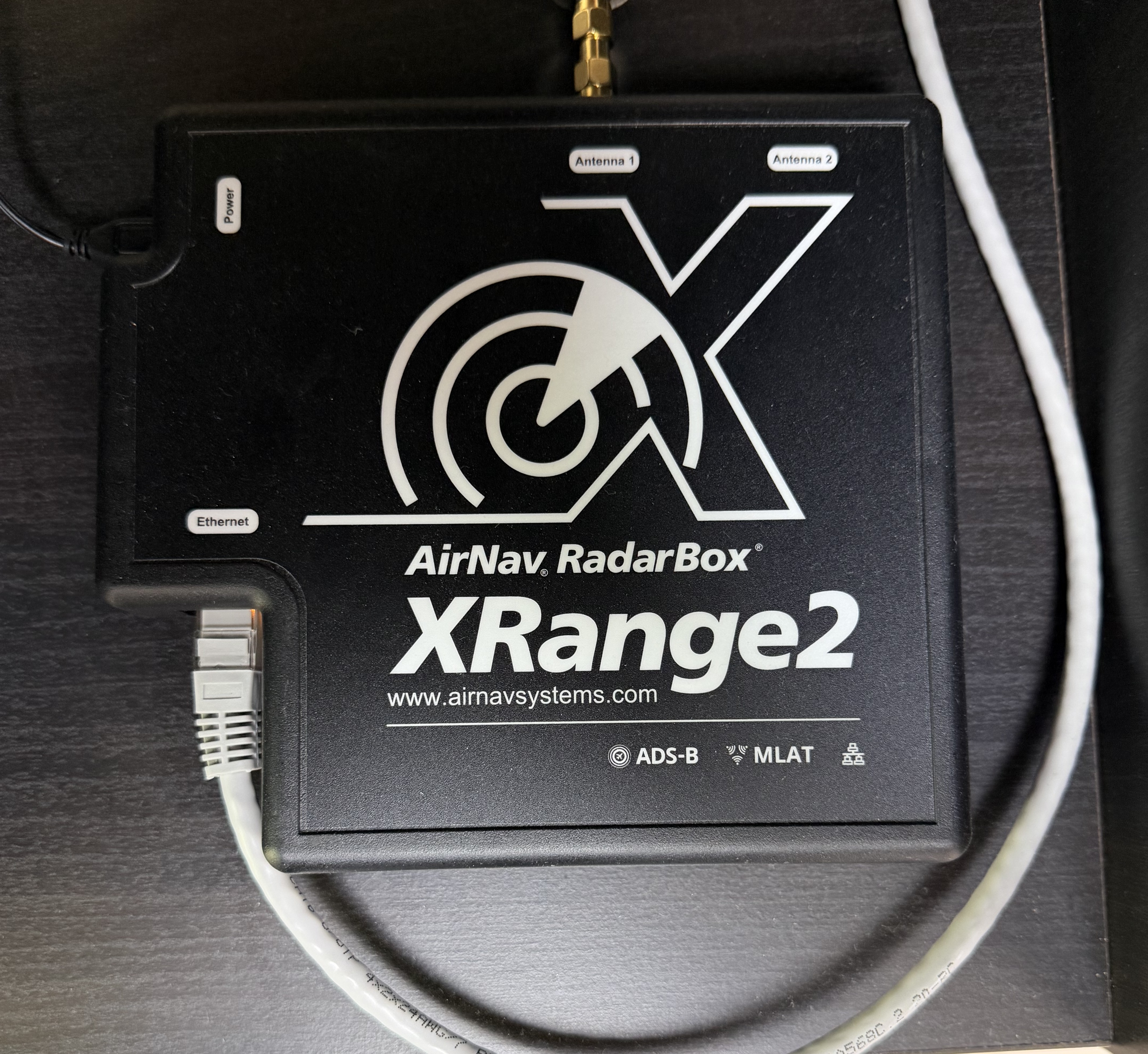
Xrange 2
Su trayectoria en el ámbito del ADS-B comenzó en 2009 , durante los inicios del seguimiento de aeronaves, cuando las redes de alimentación de datos en línea y el MLAT aún estaban en sus comienzos.
Durante una visita a la Exposición Internacional de Radioaficionados en Friedrichshafen, Alemania, adquirió su primer receptor de radar AirNav . Esta experiencia despertó en él un interés duradero por la tecnología ADS-B, los sistemas de antenas, el rendimiento de la recepción y las formas de optimizar una estación de seguimiento de aeronaves.
Hoy, en 2026, ese interés inicial ha evolucionado hasta convertirse en una moderna estación de radar AirNav alimentada por un receptor AirNav XRange2 .
Kuwait

Zairon, CC BY 4.0
Kuwait , {{cite web|url=https://en.oxforddictionaries.com/definition/kuwait|title=Kuwait – definition of Kuwait in English|access-date=5 May 2017|work=[[Lexico]]|archive-url=https://web.archive.org/web/20170822094236/https://en.oxforddictionaries.com/definition/kuwait|archive-date=22 August 2017}}{{cite web|url=https://www.merriam-webster.com/dictionary/Kuwait|title=Definition of Kuwait by Merriam-Webster|access-date=5 May 2017|work=[[Merriam-Webster]]|url-status=live|archive-url=https://web.archive.org/web/20170501044034/https://www.merriam-webster.com/dictionary/Kuwait|archive-date=1 May 2017}} {{langx|ar| ٱلْكُوَيْت}}, {{transliteration|ar|al-Kuwayt}}, {{IPA|afb|ɪl‿ɪkweːt}} or {{IPA|afb|lɪkweːt|}}"}},"i":0}}]}"> oficialmente el Estado de Kuwait , es un país de Asia Occidental . Con una costa de aproximadamente 500 km (311 millas), está situado en la cabecera del Golfo Pérsico, en el extremo nororiental de la Península Arábiga , limitando con Irak al norte y con Arabia Saudita al sur .
Una estación de Kuwait sencilla pero potente
A lo largo de los años, Abdullah experimentó continuamente con la posición de la antena, las líneas de alimentación, el filtrado y las configuraciones del receptor. Su objetivo siempre fue el mismo: maximizar el rendimiento de la recepción manteniendo la fiabilidad de la estación.
La configuración actual es intencionadamente sencilla. Su XRange2 está conectado a unos 10 metros (32 pies) de cable coaxial de baja pérdida y a un filtro dedicado de 1090 MHz . La antena está instalada en la azotea de su edificio en la zona industrial de Shuwaikh, a unos 40 metros (130 pies) sobre el nivel del mar , con la antena ADS-B montada en un mástil de 6 metros (20 pies) .
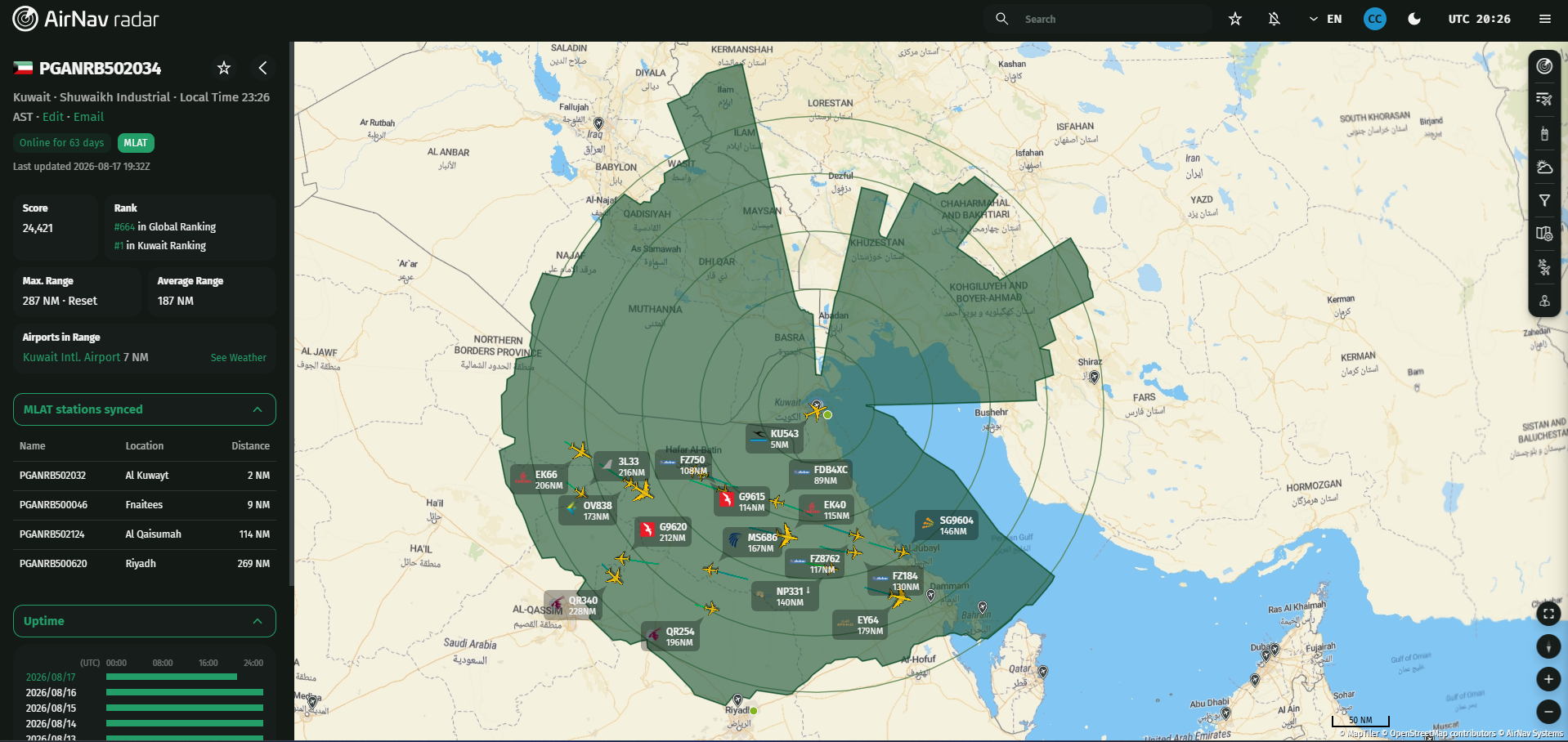
Su posición elevada proporciona una excelente visibilidad y una vista despejada del horizonte, lo que ayuda a la emisora a lograr una amplia cobertura en Kuwait y la región circundante del Golfo.
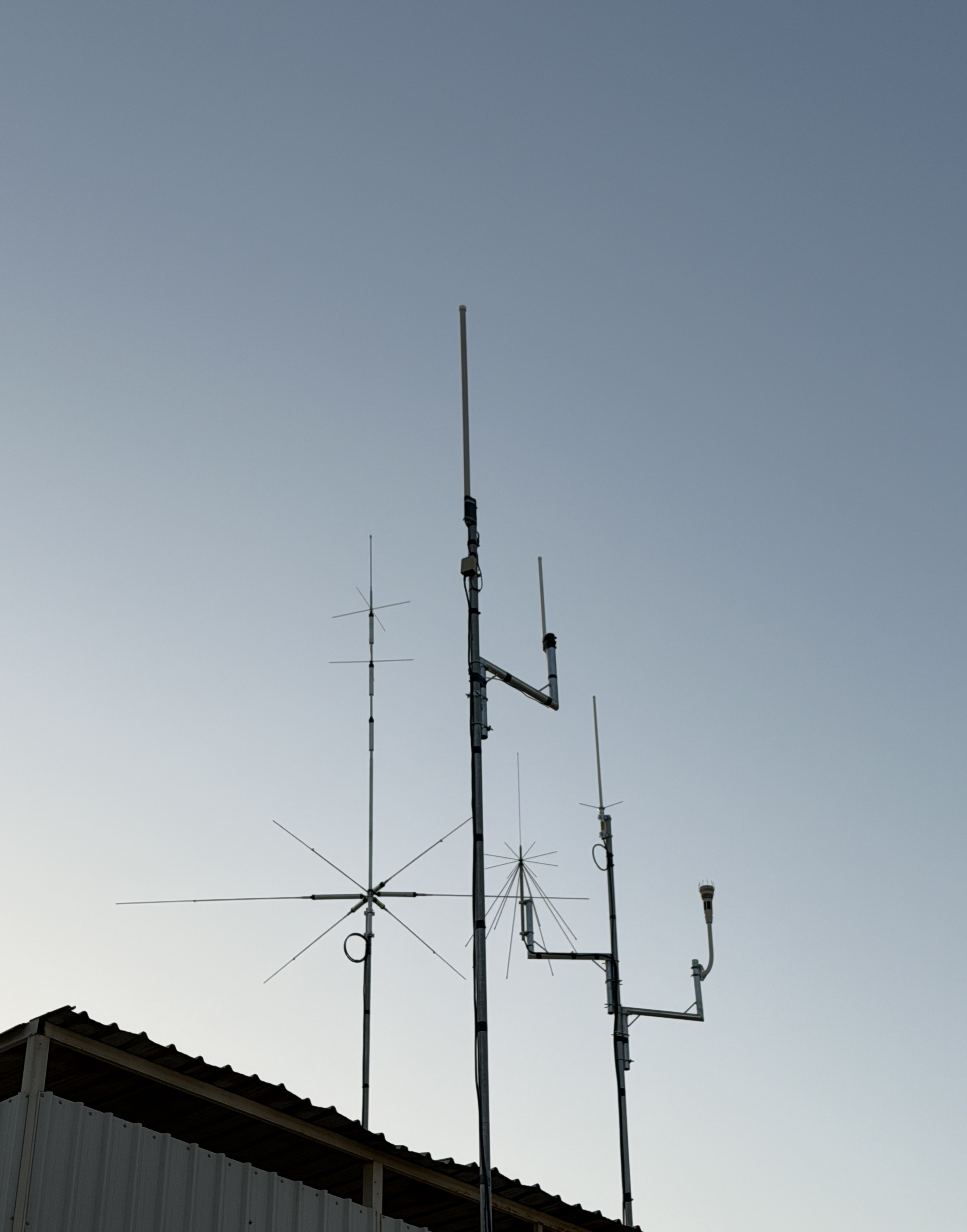
Su configuración
- Estación: PGANRB502034
- Ubicación: Zona Industrial de Shuwaikh, Kuwait
- Alcance máximo reportado: 287 millas náuticas
La misma instalación en la azotea también alberga una antena AIS para ShipXplorer, lo que permite a Abdullah monitorizar el tráfico marítimo en todo el Golfo Pérsico.
Conectando el Golfo a través del MLAT
Uno de los aspectos más fascinantes de la estación instalada es su contribución a la MLAT (Multilateración) . Su estación se sincroniza regularmente con otras estaciones MLAT en Kuwait, Arabia Saudita, Bahréin y Qatar , lo que permite que varios receptores trabajen juntos para mejorar la precisión de la posición de las aeronaves en toda la región.
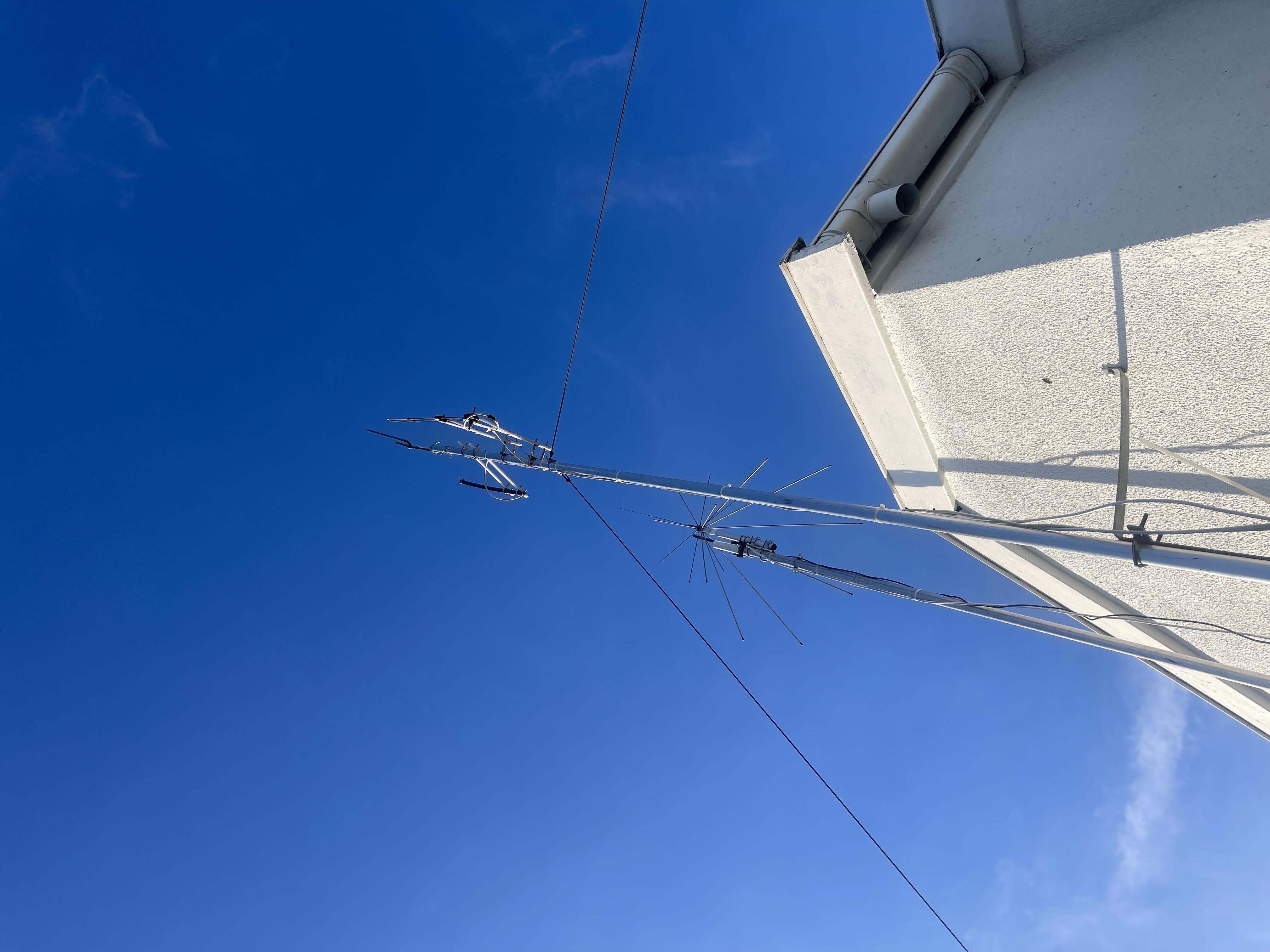
Su configuración
Para él, este es uno de los aspectos más gratificantes de participar en una red ADS-B global: un único receptor local pasa a formar parte de un sistema mucho más amplio que conecta a los entusiastas de la aviación y las fuentes de datos a través de las fronteras.
Por qué importa la posición de la antena
Tras años de experimentación con la recepción ADS-B, Abdullah ha desarrollado una filosofía sencilla para cualquiera que inicie su propia emisora: mantener la sencillez y optimizar primero los aspectos fundamentales.
Una de sus principales recomendaciones es minimizar la longitud del cable coaxial siempre que sea posible, ya que las pérdidas en la línea de transmisión pueden afectar significativamente el rendimiento de la recepción. Considera que mantener la longitud del cable por debajo de los 10 metros (32 pies) es un buen objetivo.
Una visión panorámica de 360 grados del horizonte también es sumamente importante. Los edificios, las estructuras cercanas, los equipos de comunicación y otras fuentes de interferencia radiofrecuencia o electromagnética pueden afectar la recepción.
Como bien señala, cada estación es diferente. Lo que funciona a la perfección en un lugar puede no funcionar necesariamente en otro. En muchos casos, mejorar la ubicación de la antena puede ofrecer mayores beneficios que simplemente añadir más equipos.
Conciencia en tiempo real
Para el radioaficionado con larga trayectoria, una de las mayores ventajas de contar con una estación de radar AirNav es la información en tiempo real que proporciona.
Entre sus funciones favoritas del radar AirNav se encuentran las notificaciones instantáneas de códigos transpondedores, que le permiten detectar códigos especiales como el 7600 , y las capas meteorológicas integradas de la plataforma.
Estas herramientas añaden una nueva dimensión a la monitorización de aeronaves, transformando la recepción ADS-B, que pasa de ser simplemente la visualización de aeronaves en un mapa a una experiencia de conocimiento aeronáutico en tiempo real más completa.
De los aviones a los barcos
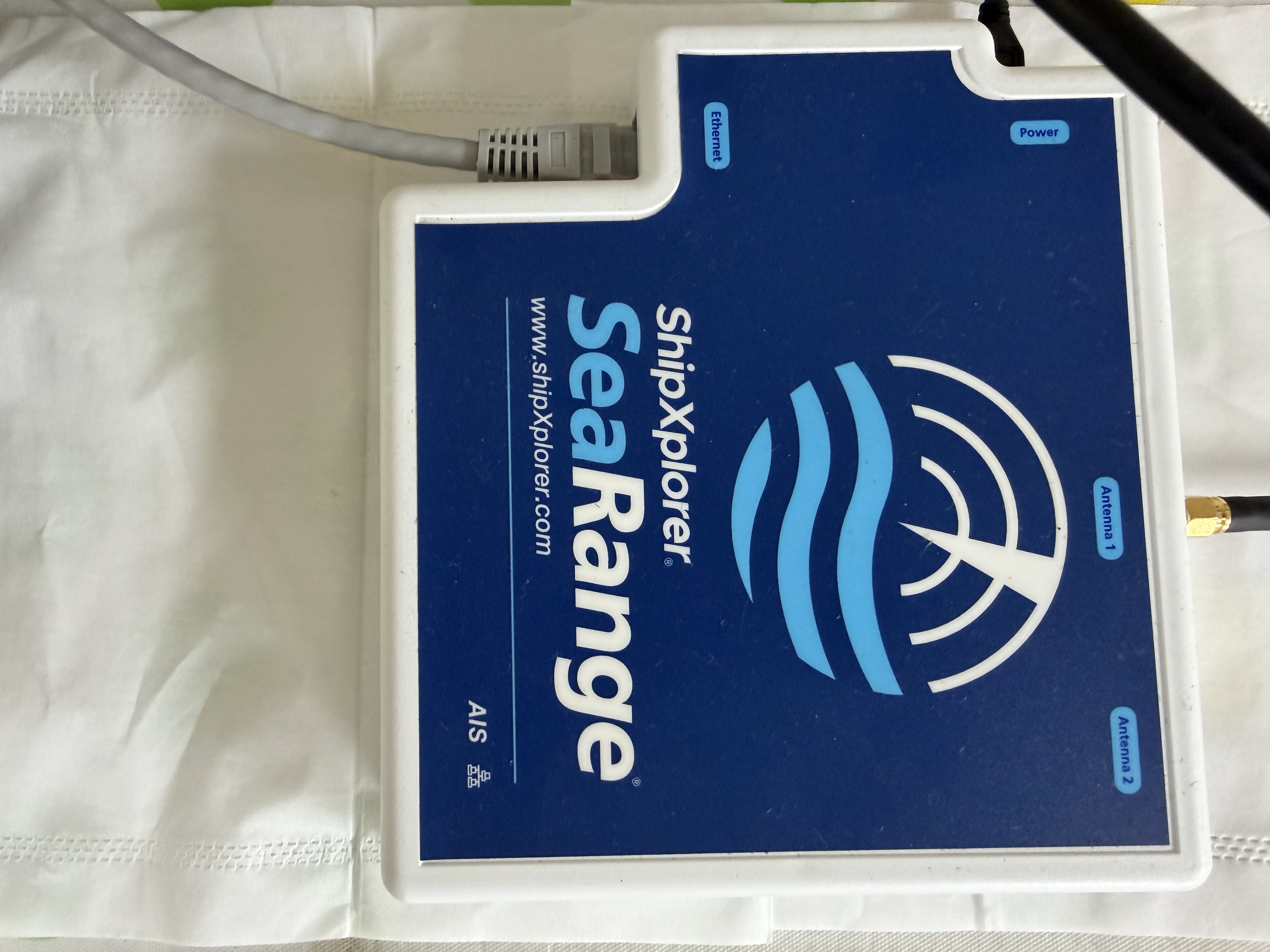
Receptor AIS SeaRange
Su pasión por la monitorización no se limita a la aviación. Además de su estación AirNav Radar ADS-B, opera una estación de monitorización marítima AIS para ShipXplorer , que proporciona visibilidad del tráfico marítimo en todo el Golfo Pérsico. En condiciones de propagación favorables, su estación puede recibir señales de buques situados tan lejos como la costa de los Emiratos Árabes Unidos.
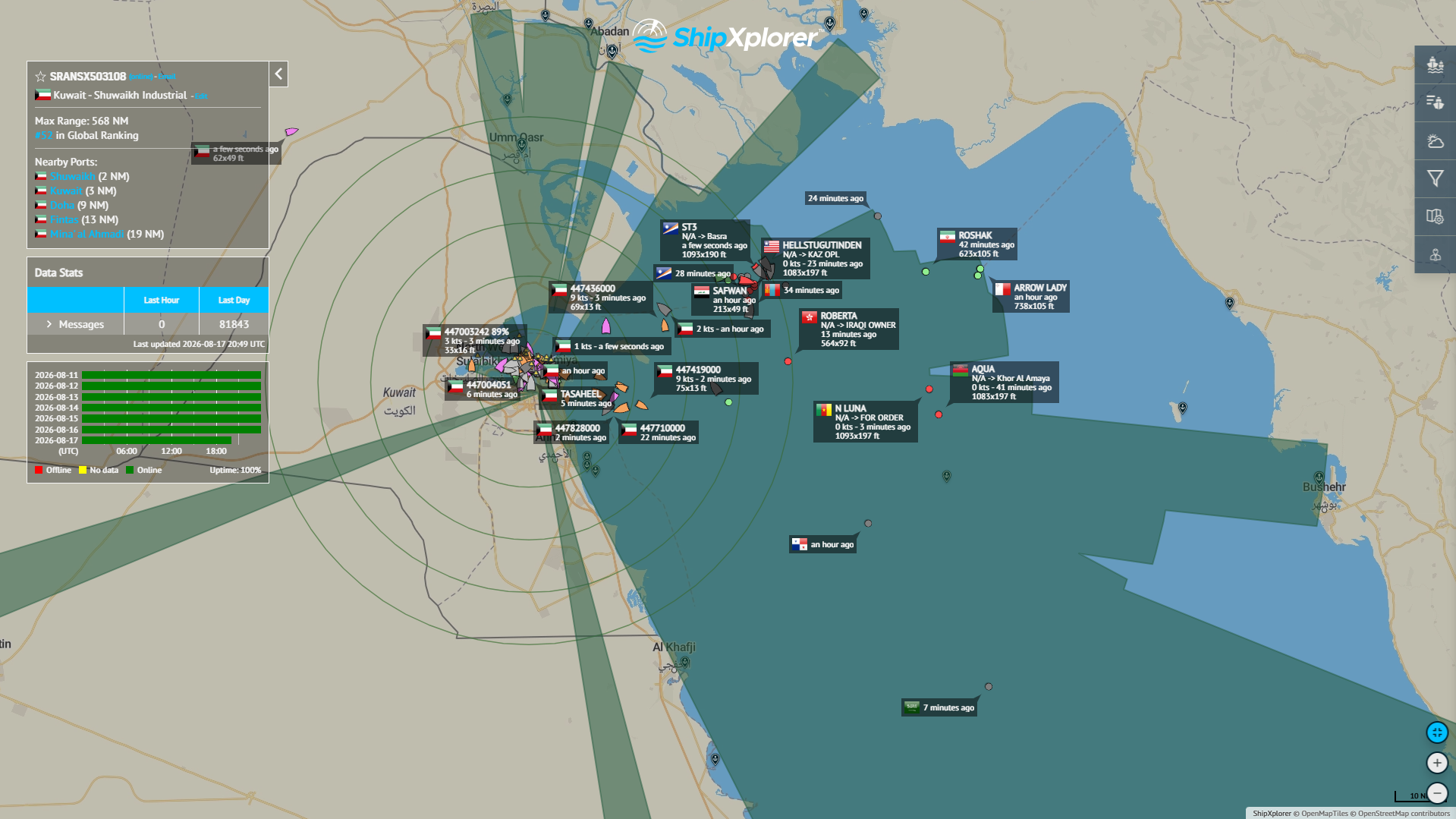
Estación AIS SRANSX503108
Esta combinación de vigilancia aérea y marítima le permite seguir dos formas de transporte muy diferentes utilizando principios similares de recepción de radio, antenas y optimización de la señal.
Únete a la red de radares de AirNav
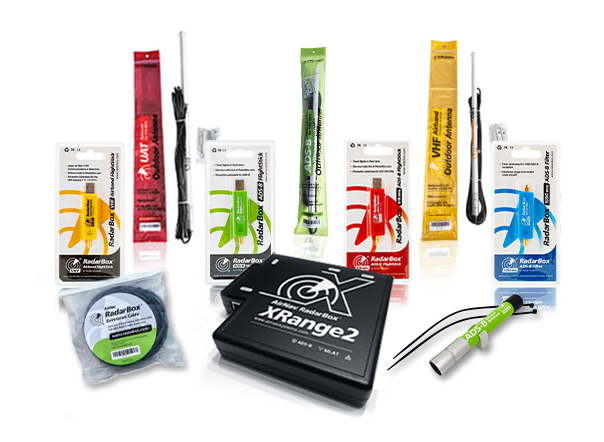
Descubra nuestros productos centrados en hardware ADS-B y explore la tienda de AirNav Radar aquí .