Preliminary NTSB Report Points to Engine Separation in UPS Cargo Jet Crash

NTSB says a catastrophic structural failure caused a UPS cargo jet to crash moments after takeoff from Louisville on November 4, killing all three crew members and eleven people on the ground. The findings come from a preliminary report released by the National Transportation Safety Board, which describes a violent separation of the aircraft's left engine and pylon assembly just as the MD-11F began to lift off. The accident also injured twenty-three people on the ground.
UPS Flight 2976 departed Runway 17R at Louisville Muhammad Ali International Airport at about 5:11 p.m. on a scheduled cargo flight to Honolulu. According to the report, the takeoff roll was routine. Seconds after rotation, however, airport surveillance cameras captured the left engine breaking away from the wing and passing over the fuselage while on fire before falling apart near the runway. A fire simultaneously erupted at the pylon's attachment point on the wing.
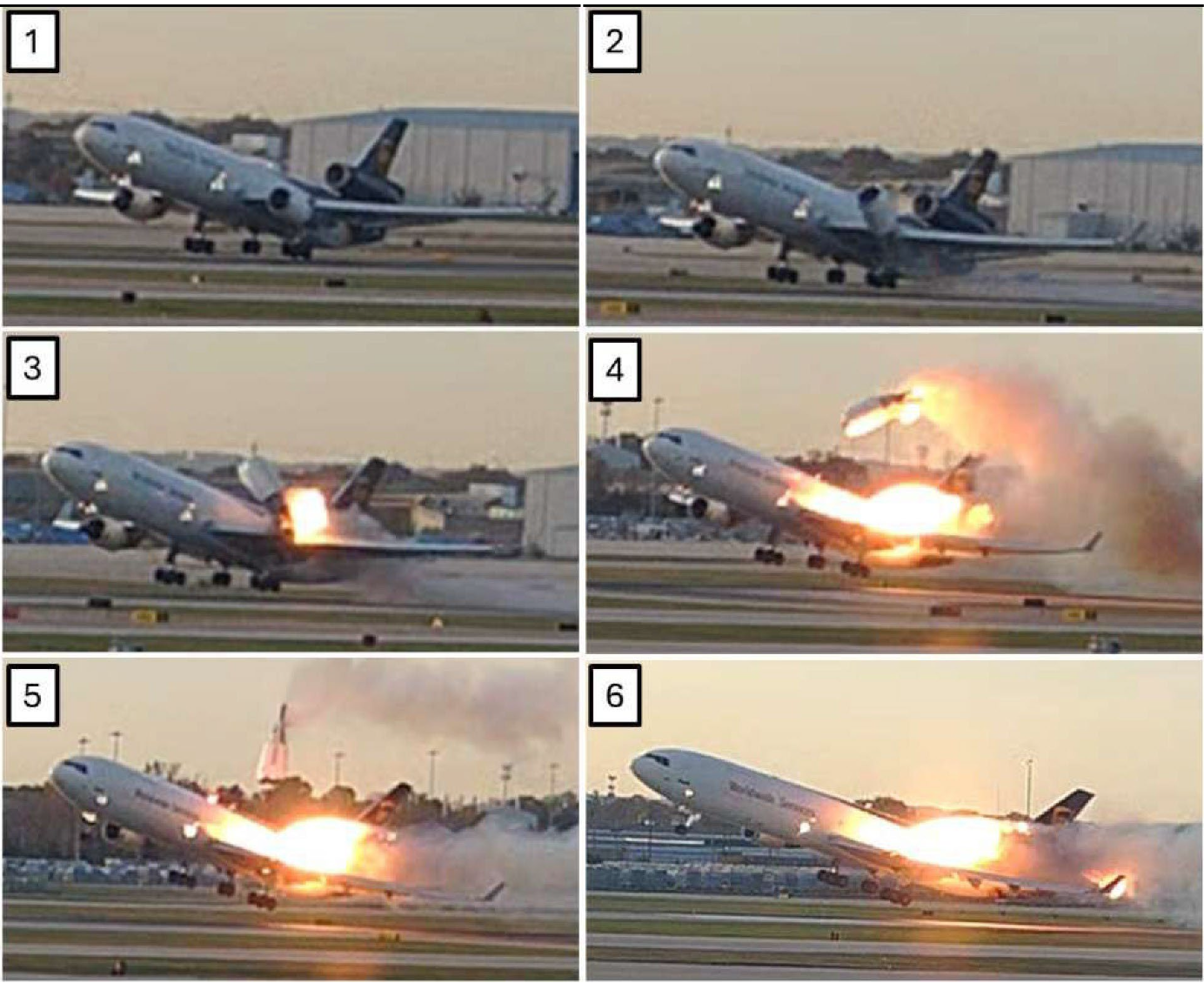
Still images from an airport surveillance video showing the left engine and left pylon separation from the left wing. (Source: UPS)
Data from the aircraft's flight recorder shows the jet climbed no higher than about 30 feet above the ground. In comparison, FAA ADS-B data indicated a brief maximum of roughly 100 feet before the aircraft began descending. The jet managed to clear a blast fence at the end of the runway but struck the roof of a UPS warehouse with its left landing gear. It then crashed into a nearby storage yard and several industrial buildings, including a petroleum recycling facility, where it was consumed by fire.
Air traffic controllers told investigators that while the aircraft's takeoff speed looked normal, its climb rate was not. Witnesses reported the airplane failing to rise above the height of the control tower and beginning to roll to the left before impact.
A key question after the crash has been why the airplane did not gain altitude, given that the MD-11 is designed to climb safely with one engine out. The NTSB report clarifies that this was not a standard engine failure but a major structural breakup. Investigators found the left engine, its pylon, and the critical mounts that attach the assembly to the wing scattered along the runway. Early laboratory analysis revealed fatigue cracking in the pylon's aft mount lugs and a fractured spherical bearing, indicating that the structure had already weakened before takeoff. When the engine tore away, it damaged the wing's leading edge, compromising its aerodynamics.
The damage caused an immediate loss of lift on the left wing, considerable asymmetric drag, and reduced roll control. Even though the aircraft's two remaining engines were still operating, the jet was too low, too slow, and too structurally compromised to climb. With the failure occurring at roughly liftoff height, the crew had no altitude or time to recover.
The chain of events is similar to the 1979 crash of American Airlines Flight 191, where a DC-10 lost its left engine and pylon during takeoff and became uncontrollable. The NTSB notes that tragedy is a relevant historical parallel to what happened in Louisville.
In the days following the Louisville crash, UPS grounded its MD-11 fleet at Boeing's recommendation, and the FAA issued emergency airworthiness directives grounding MD-11 and DC-10 aircraft until inspections of their engine pylon mount assemblies could be completed.
The final report and investigation are still ongoing and could take anywhere from six months to a year to be completed. In the meantime, questions remain: Why did the left engine separate from the wing? How could an incident similar to the one in 1979 happen again? Was the crash caused solely by the loss of the engine and the resulting fire, or was it the result of multiple system failures triggered by the engine separation? These are the questions that the final report aims to answer.
.png)
.png)

